“And the Lord spoke to Moses saying “Phinehas…turned away My wrath from the Israelites when he zealously acted for My zeal in their midst.”
Pinchas Numbers 25:6
All communities are peaceful until they’re not. What maintains the peace? I looked at our own community and believed I found a good set of principles. First of all, everyone must be fed. Our community was perfect in this way, as we were self-sufficient. A great pleasure I would take every day would be to step outside my home, set on a hill overlooking our valley, and survey the natural beauty and resources that we were endowed with. To the north were farms which produced a variety of fresh and delicious vegetables. To the west was our grazing land, rich with black and white cows that gave us all milk and meat. The south and east were where the population was concentrated. I imagine that our craftsman would be the envy of the world. I received the shoes now on my feet over seven years ago, and I imagine they could withstand another seven.
Also maintaining the peace is firm leadership so that the people know what their place is in the community. The shoe maker knows the ration of milk and meat and vegetables they will get, and is bound to produce the shoes of proper quantity each month so that no one goes barefoot, and so that their own family is fed. This needs careful planning, decision making, and direction from the Leader. My own place is one of privilege and honor. I live in a small home attached to the palace, where I may consult freely with our Leader and communicate his intent to the elders, who in turn pass these words to the people closest to them, and so on, until each individual knows the direction they must take.
All communities are peaceful until they’re not, and I began to see chaos and conflict begin to invade our community. Some invasions are, of course, rapid and violent, but these have the advantage of resolving themselves quickly, whether for better or for worse. Our own was the sort that comes from the rats that first sniff at the edges of bags of grain and then scratch and dig their way through until they finally burrow their way in for a feast. They were outsiders from the community to our south, seeking our most precious resource: the affection of our men. We sent out spies and learned that there was an illness in their own location which rendered their own men incapable of creating new life. They had become a land without children, one that aged every year with no renewal. Then a movement arose, and women who could still bear children dispersed, and some of them embedded themselves in our own community which had until now been sheltered from this influence.
Our Leader sought my council on how to handle the issue. I advised him that we should gather our men and drive these intruders back to their own land. I communicated this to the elders, but one of them, Mister P, objected strenuously. He said that these foreign women had already won over the affection of our men, who now would refuse to drive the invaders out. At first, I thought that Mister P was simply speaking for himself, that he had been one of those charmed, and that he desired to maintain the status quo. However, I learned that this was not true. He had long been married to a local woman and already had two children with her. Worse, he proved to be correct even beyond what he had first predicted. While only a minority of men had taken up with these intruders, I found that even those who had local wives or lovers also wanted to protect the interest of those friends of theirs who benefitted from the intruders. My next suggestion was much better thought out – that we should enlist our community’s women to drive out these rats. Again, Mister P discouraged this. “What harm is there in this if it keeps our men happy and productive? The women will get what they desire: children of their own which they left their land searching for. Those children will be raised here and will learn our customs and become just like us. Their fathers will anchor these children to our community.”
I pleaded with our Leader to not overlook the long-term threat as a way of maintaining short term tranquility. Deep within these children would be blood that had the potential to split their hearts in two, and by extension, our entire community.
I undertook to persuade him by gathering more information. I ventured down from the hill, dressed myself as a craftsman, and spent my evenings at several of our taverns, engaging in conversation with these men who had become emotionally involved with the invaders. It was in this way that I learned of the most insidious aspect of this invasion. These foreigners had no leader, saw no need for one, and had loyalty only to themselves. Predictably, these women allowed their ideas to burrow into the minds of their lovers. I had the following conversation with a man, Mister Z, over an ale.
“Enjoy your ale,” he told me. “I get allotted two pints of this a month, which is fine, and I have enough to feed me and my partner. But I’m a builder of houses, and a better one than all the others I know of. People fight for the right to hire me as their builder. But our Leader simply assigns me to whoever happens to have his favor. If I could choose the families that I build houses for, and they could choose me, we could come to an agreement that would benefit us both. Instead of two pints of ale a month, I might have four or even six. I could work to have more meat than my ration. And only those who need the highest quality homes would offer what my services are worth. It grieves me to see my good work often wasted on those who have no appreciation for it, and whose only merit in obtaining my service is the fact that the Leader happens to favor them.”
I could not believe these words were spilling so freely. “But surely, you understand that our Leader loves us all. We would live in a community of chaos without him. How would you find the things you need for your sustenance if not for the system of his judgement that guarantees our equity?”
“I would find them myself, and they would find me. That’s how it is in the south. They have no Leader because they need no leader. This is their dirty secret but it is no longer a secret, nor should it be seen as dirty. Truth is never dirty. Speak with other men who have learned about how it is in the south, as I have done. This discovery has opened their eyes. They are understanding their potential for happiness. It doesn’t require our Leader, and in fact is only tamped down by him.”
Suddenly my ale seemed sour and I could barely finish it. My excitement and rage caused it to catch in my throat and try to choke me. Through my coughing, I struggled and thanked the man for his insight, apologized for my need to leave hastily, and I used all my breath and energy to return up the hill back to my home.
It was already night by the time I returned. I was restless with anxiety to inform our Leader of how indeed these foreign women had captured not just the affections of so many of our men, but their loyalty as well. Without this loyalty to our Leader, the entire cohesion of our community could unravel, just like a knit woolen garment that has had just a few stiches cut open.
“Leader, you surely recall how I voiced my concerns about these foreign women. Last night I went into the valley and spoke with men who have aligned themselves with them, and I learned that the reality is a greater threat than even I imagined. The women come from a place with no leader. They live untethered to any loyalties other than to themselves. They claim that such leadership is superfluous and even destructive. And worst of all, as I am sure you are beginning to anticipate, they have persuaded the men with whom they live that their way is the better way. The men are being turned away from you and from the greater good of our community.”
“I have always been wise to have you by my side,” he told me. “By descending among the people, you have again shown your thoughtfulness and loyalty, and you have opened my eyes when they were clouded by my own comfort. We have built a beautiful society here, so beautiful that I believed that it could withstand any storm from outside. We are instead in great jeopardy.”
“I will bring the elders together,“ I offered. We will work with every man who will listen. We will work with the women of our community as well, who have the greatest stake in this. Together we will drive these foreign women back to their southern lands. They may even carry children in their bodies, but these are fruit of a poisonous tree, and we will all be better off if they are raised far away, alongside their corrupt mothers. Their fathers will find new families here with their own people.”
“This time it is you who underestimates the threat,” our Leader cautioned. “The way you have described it, the women have already sown their corruption. The women as well as their men must all be destroyed. Gather the forces you promised but use them unsparingly. We must make a statement that cannot be misinterpreted in any way as weakness or ambiguity. A community is bound by its loyalty to the greater good, and I stand as the figurehead of this good. Assemble the elders and act assertively.”
“I have served you with the greatest loyalty. We have disagreed in the past, and always parted with mutual respect. Please keep this in mind when I beg you to show greater mercy. I believe that we can restore our world simply by driving out the corrupt influence. The men who remain will return to the values that we have lived by for all of our lives.”
“Thank you for your council. It’s true that I have been mistaken at least once in the past, and should have heeded your advice. The stakes today are too high. I stand by my judgement and I believe that time will prove me to be correct in this. I have nothing to say more than this: kill them all.”
The anxiety I felt when I first met the man in the tavern now seemed trivial compared to how I felt now. If I could, I would have taken back all my council. I would have said nothing. I would have let these people live their lives and hoped that my fears were unfounded. If I could, I would have never even entered the tavern.
I called a meeting of the elders fully expecting to compel my lips to speak the words I had been demanded to in such a way that they might bypass how my heart felt. I recalled a time when I was a boy and, in my carelessness, I allowed myself to be bitten by a venomous snake. I knew what I needed to do: to take my knife, cut a gash in my own arm, and suck out the venom. But even when I knew my life depended on it, I could not make the cut. We sometimes resist doing what we know we must do. My life was saved by a friend who struck me in the head and then performed the healing operation on me while I was unconscious. So it was this day. Instead of issuing the harsh direction, as duty compelled, I told the elders that our Leader had first suggested the possibility of cleansing our community through merciless violence, but then I lied. I told them that I had persuaded our Leader that we would first drive these disloyal women out and give the men a chance to repent and affirm their loyalty. We would watch them carefully to ensure that they remained true to their word and that our community was restoring itself and its natural values.
It was here that our elder Mister P spoke up. “What makes you even believe that our community is in jeopardy and that these women are corrupting the minds of their men?” I told him of my descent into the local tavern and of the disturbing words I heard from Mister Z. “From this one man you throw guilt on them all?” Again, I tried to explain how Mister Z was not alone, and of how this was a much greater infection in our community than only what was visible. “Grant me one day to address this,” he said. After that, we will follow your advice.”
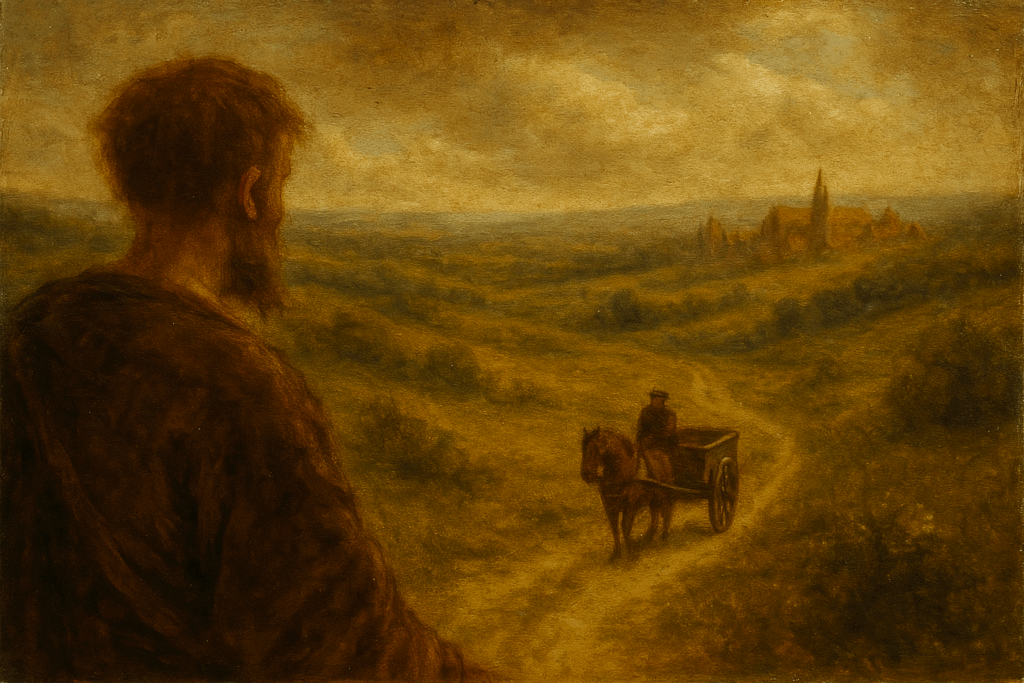
I did not even need to grant him that one day as he acted with astounding alacrity. The next morning, I woke up and heard great shouting from the valley, enough even to reach my home at the top of the hill. I looked down and saw a great crowd gathered around a horse-pulled-cart that was making its way up the path to reach me, led by the elder Mister P. The crowd left it alone as it reached the point on the way that was forbidden to them, and in time Mister P presented me with the cart. As the cart rounded the top of the hill I was able to look in and see two bloody bodies. I immediately recognized one as being Mister Z, the gentleman who had spoken so candidly with me at the tavern. The other was that of a woman, obviously one of the outsiders, who I presumed to be Mister Z’s partner.
Mister P came close to me, almost nose-to-nose. “I brought this cart and its contents all around the community so that they might see the corruption and punishment embodied here. I’m leaving these bodies here for you to provide the explanation to our Leader. If he becomes enraged, tell him that I did this. I accept any punishment because I know I did the right thing. I believe I know our Leader’s mind better than you, and perhaps I know it better than he does.” And with that, he overturned the cart, letting the bodies spill out onto the ground in front of my home. He unburdened the horse that had pulled it, and he rode back down into the community.
I knew that I had failed our Leader once but I would not fail him again. I could only hope that he would forgive my cowardice and interpret it as a reasonable mercy. However, there was no way for me to lie about what I had done, nor any excuse if I were to try to do so and then be found out. I brought our Leader personally to where the bodies lay and told him of Mister P’s actions.
“Nothing you say surprises me.” What a cryptic thing to say. Had our Leader long suspected me of having a heart that ruled over my will? “Usually, I leave it to you to speak with the elders, but I ask you to bring this man to me so that we may speak directly.” I summoned for Mister P to come the following morning. He arrived with an angry and defiant look. As I brought him to appear before our Leader, I stepped away to return home, but our Leader stopped me. “This affects us all. Mister P’s actions have addressed the threat in a novel manner. Mister P, you are to go back into the community and find a replacement for yourself to serve as the elder of those you had represented until today. I now elevate you to the position of my counselor. The man beside you, who had been my counselor, will now serve your own needs. Take over his home. Find him new lodgings on the hill. You may, if you like, seek council from him, as he has wisdom that surpasses his apparent cowardice. He is also an effective communicator, and you may wish to use him to spread my word among the remaining elders. From this day forth, he will no longer communicate with me directly.”
These words from our Leader made my soul shrivel. I had gone from being the bridge between our Leader and the community to a superfluous link in a chain that merely hangs exposed, doing nothing to hold the rest together. In the first weeks, Mister P did come to me on occasion to seek my counsel, but even then, only on the most secondary of matters. “When meeting with the elders, should I stand and have them seated to show my superiority, or should be all be on the same level?” I told him truthfully that I’d never even given thought to such irrelevant matters. The important thing was to speak unambiguously. I wondered how the community was now doing. Had Mister P’s actions stirred the people to return to their loyalty? No word came to me on the matter and I dared not ask.
It was just more than a month until Mister P came for my counsel again, this time on a matter of substance. “The elders have asked me how it is that I came to take your place as the one who speaks directly with the leader, and how it is you fell from your position of esteem to become my servant. What shall I tell them?”
This struck me as an odd question. It was now the job of Mister P to be able to address the elders and to have the maturity of judgement to answer such questions. “Tell the truth.” seemed to me to be the self-evident advice. “Tell how you took the initiative to slay Mister Z and his consort for their disloyalty when I lacked the spirit to do so. Tell how our Leader rewarded you for your actions.” It was the first time that Mister P seemed so grateful to me, as though I had helped him out of some trouble. He offered to inform our Leader of my honest and direct counsel as a reward.
It was the morning of two days later when my sleep was interrupted by harsh shouting and howling sounds emerging from the valley. I went as quickly as possible to my favorite view point and saw something familiar. It was a horse pulling a cart up the hill, the identical cart as had been used to transport Mister Z a few weeks earlier. I realized what must be the case. Mister P had found new evidence of disloyalty among the population. It had not been quelled, and a new example was needed. But as they arrived, I saw that it in fact was another one of the elders, Mister N, leading the horse and cart. Mister N was normally a taciturn and unassuming individual, one who was most noted for nodding and smiling during meetings of elders, and rarely asking questions. I peered into the cart expecting to perhaps see one of the other men I’d met casually at the tavern, along with his own consort. I suppose I should have known better than to be surprised when I instead saw the body of Mister P, savagely bloodied, lying alone.
“Don’t be shocked,” Mister N told me, as he approached and embraced me. “The man was a danger to us all. Can you imagine his nerve? As I understand it, our Leader had asked for a full lethal cleansing of the invaders, and you had instead asked that we merely drive them out. And what did he do? He took it upon himself to pick and choose and murder whom he wished. Does he have no loyalty? Not to our Leader and not to you, but to his own fancy? Then he caps this misadventure off with arrogance, bragging to us all about his so-called ‘initiative’. In Mister P’s absence I ask you to either speak directly with our Leader and tell him how I stopped this dangerous man, or else arrange for a meeting so that I might do so myself.”
Much like the last time, our Leader asked to address both of us together. “Mister N,” he said, “I think you are quite right in this matter. I had indeed hoped it would be just a short while before another of the elders would see through my own mistake in advancing the position of a man who thinks he knows my mind better than I do. The man beside you did lack courage, and I can forgive him that to a limited degree. Mister P on the other hand showed a dangerous ambition, and he deserved his fate. As my way of thanking you, Mister N, I would like to promote you to the position formerly occupied by Mister P. Dispense of his belongings as you move to occupy his former home near the palace. As before, the man beside you will act as your own servant and counsel.”
I knew my place and I was prepared to accept it. I realized that I might perhaps never again have the direct ear of our Leader, and yet I had a question for him, and I asked if I might be granted one brief moment alone with him. I fully understood that this was a question which might lead to my own demise, but it was burning in my chest and needed release.
“We are alone. You have one question for me?”
“Will this never end?”
I had rarely in my life see our Leader pause before he spoke, and he seemed to withdraw momentarily to a place deep in his soul. When he emerged, he engaged me with a forceful and almost fatherly stare.
“I have always known you to be the wisest in the entire community, and I see that has not changed. No, it may never end. I see now that none of the feared disloyalty spurred by the outsiders in the valley compares to the dangers of ambition and initiative that are much closer to me. Forgive me when I appear to reward it, but it is my way of ensuring that this greater form of disloyalty burns itself out until the fuel has been consumed. It is all for the greater good.”
I returned to my lodgings and vowed to live out the remainder of my life in an unobtrusive manner. I served and ultimately buried many of the Leader’s counselors in the years that followed. As for the community in the valley, I chose to never inquire about the degree it returned to a state of tranquility or veered into rebellion. This was no longer within the domain of my responsibilities.