Come down to me, do not delay. And you shall dwell in the land of Goshen and shall be close to me… and I will sustain you there.
Vayigash Genesis 44:18
“You probably would never guess that I was once the wealthiest Cambodian-American in California. Maybe the country, I don’t know.”
Well, of course I knew. That’s how I pitched the story to my editors at SoCal Weekly. I had heard of The Prince of Donuts since I was a child. I think every Cambodian in California knew about Tim Tek. In high school, two of my friends worked in a family donut shop that Tim financed and helped to build. And his donut shops were everywhere. But I wanted to see if I could get him to tell me more about his downfall.
“I once lived in a five thousand square foot mansion in Palos Verdes. Now – an eight hundred square foot apartment.”
But in Beverly Hills, I reminded him.
And even here in this modest apartment, he seemed relaxed and open, as though he were hosting me in his long-gone mansion. He invited me in with a smile that began to catch me off-guard. I imagined his smile similarly infecting all the dozens of families he had sponsored from Cambodia.
“Yeah, I’m in Beverly Hills,” he laughed. “The slums of Beverly Hills. But I like having a Beverly Hills address. It makes me feel wealthy. And I had a beautiful wife. Now I am alone.”
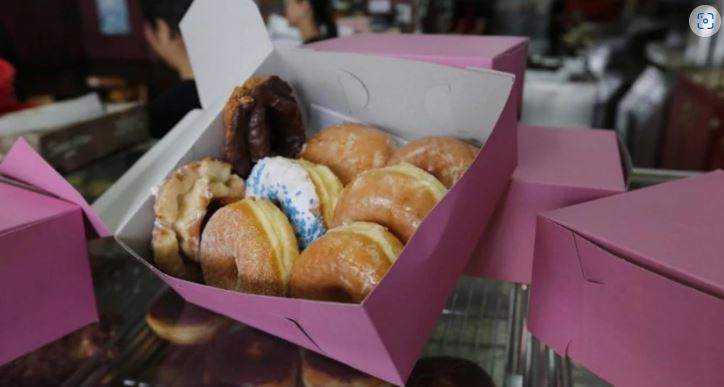
I looked around the apartment. Tim didn’t spend a lot of time keeping it orderly. He was sitting on a small pile of his own clothes inside a big comfortable chair; the fabric on the arms had bits of thread pointing out of them. Many of the decorations on the walls were just fastened with tape – often yellowing newspaper articles about himself, his wife Tami, and his business. One funny “decoration” was a pink donut box. It was flat, unassembled, and Tim had actually taken the time to frame it. It seemed to be the symbol he was most proud of.
He offered me a donut. I asked him if he made it.
“No, I let other people make donuts. Now I just make the holes. I made the holes for twenty years.”
“The reason I became successful in donut shops was because I didn’t like making donuts. When my wife Tami and I opened our first donut shop, I worked very hard. I had no one to help me. No family, like the others do. So, I made the donuts, and Tami worked in the front with the customers and with the money because she was much prettier than me, and her English was better than mine, and so the customers loved her.
“Making donuts is hard work. We worked twelve hours a day, six days a week. Most of the time I’m standing near hot oil. I would sometimes go home at night and cry with her. For two reasons. One was that I was working so hard. The other reason was that we had no children. I wish I had a child who could help me in the store. But we knew that would take many years and I needed both of us in the store. We could have hired someone, but I did not know how to trust people then. How would I know if they were stealing?”
I thought it was interesting that Tim made things more difficult for himself because he couldn’t trust people. But a lot of people put their trust in Tim. I suppose that not having any employees, and not having to pay anyone else to start him up – that’s how he saved so much more than anyone else.
“But hard as it was, I always remembered. Donuts saved my life. When the Communists took over in Cambodia, I thought I was safe because even though I worked for the government, I was not political. I just made things run smoothly. I had a big rubber stamp and I approved almost everything. Then early in the morning I heard a knock on the door. It was my best friend who told me that the Khmer Rouge were coming on my street and that I had to escape with the Americans right away. Tami and I left with nothing but our clothes and we were rushed to a helicopter. Only after we were in the sky, when I felt like I wanted to throw up, did anyone tell us that both of Tami’s parents had been shot because they had a store and too much private property. I knew nothing about my own parents then, but I hoped that they were poor enough to be left alone. So, after being settled in California by the United States, I had nothing, and I knew nothing. I worked, learned how to bake, and eventually had my own store. I am alive today because of my donuts.”
This was all old news. We all knew how he escaped. Every one of us who escaped the homeland had a similar story, although most of us got out much later, when Pol Pot had been sending many families out of the cities to work on rural communes. And dozens of us got out, for better or worse, because of Tim. So, I had to steer him to that part of the story.
“Sure, you’re alive because of donuts. But that’s not what made you wealthy, right?”
Tim fell into his great smile, leaned back on the sofa, and gave his familiar joke.
“Not the donut. The holes!
“I wrote to my brother, who was left behind in Phnom Penh. He told me that my parents were still alive. So I got them out and brought them here to Los Angeles. I wrote to my brother’s wife’s father and his wife’s two brothers and told them, you can escape Cambodia, where there is nothing but poverty and fear, and you can come to America, to California. You can build something here. Donuts will make you free!”
“And you set them up with their own store, right?”
“Exactly!”
“But at a price?” I reminded him.
“Well of course! But a fair price! They all had families that could work in the store. I had lived in America for three years now. I knew exactly how much a donut store could make and I knew how much it cost to live here and support your family. So the difference – twenty-five percent – that’s how much I asked. I gave the training. I used my savings to get them started. I knew where they could find a good place to begin and how to negotiate a fair rent. They had what they needed, and I made a profit. They made the donuts. I made the holes.”
I was getting him to where I wanted him. The holes.
“When you say you made the holes, you’re really saying that they did the work and you did nothing.”
Tim stopped and looked at me – half as though I had insulted him, but half as though he thought I was stupid.
“Tell me, what do you do for a living?” he asked me.
It’s not his place to ask the questions, but sometimes you’ve got to go along with someone to get their trust.
“I’m a journalist.”
“You write stories, yes? You make them up?”
Not sure where he’s going with this. “No, I tell the truth. I interview people like you, and I tell their stories.”
“Ok, so they do the work, and you just put words on the page, and you make the money. Let me tell you, when I say ‘I make the holes’ – I mean I build the business. I find the location. I train. I lend money for the equipment. Most of all, I bring people away from the starvation and pain in Cambodia to here in Los Angeles. There are over two hundred people here – almost a hundred families – who survive in America – with a shop they can run with my help.”
“Are they grateful?” I asked.
“I don’t ask anyone to be grateful. I ask them to live and survive. And if they do that, I get rich. At least I used to get rich. Everybody works. Some of us work in the shop; some of us help build the shop up from nothing.”
“What about your wife’s cousin, San Paou?”
“San sometimes complained that he was just keeping his head above the water, while I was getting rich. But that’s okay. I already told you. I don’t ask anyone to be grateful.”
He was avoiding the subject I wanted to get to, so I had to approach it from another angle. I would have to be careful or the whole interview could end suddenly.
“And so,” I added, “no longer tied to making donuts, you had time to try to have a family.”
He had been expansive for so long. He had been the smiling, warm, Tim Tek, Prince of Donuts, since I had walked in. Now he looked at me suspiciously and his shoulders tightened.
“Why do you bring that up?”
“It’s part of your story,” I told him.
“We tried to have a family. Now that I didn’t need anyone working in the store, I just wanted someone that I could love and nothing else. But Tami had three miscarriages. And then finally we had a daughter, the most beautiful child I had ever dreamed of. More beautiful than I had ever dreamed. We had her one year. Exactly one year. Her first birthday we want to come home from her party at my parents’ house, but the car seat couldn’t tie down. I’m impatient so I ask Tami to carry her on her lap. We are getting off the freeway. Then BOOM! A car hits us. On this side here, Tami’s side. Tami broke her shoulder but nothing else. But Jessa flies through the window. I’m alive. But I’m really dead.”
“That lasted a while, didn’t it?” I asked.
“I brought no one to Los Angeles for a year. I started no donut shops. I just stayed in my beautiful house. I hardly ever left. Nothing could cheer me up. Even Tami could not make me happy.”
“But San Paou…”
“After a year of death, I mean my own death, San Paou came to me and said, ‘Tim, you need to be happy again. And he gave me some cocaine. I felt like I was pulled out of the grave. So, he brought me more. Those were good times. You have no idea what a difference it made, finally being able to see the world again after living in the grave for a year. But eventually he had no more and I had to find more on my own. I had to do anything to stay out of the grave. But cocaine is expensive. I was thinking of nothing else.”
“And so that’s when things started to fall apart, right?”
“Starting? No. Things were already falling apart. My money started to disappear. Then I had to go with my hat in my hand. Starting with my father and brother, I asked to borrow money. I told them I needed more money for the business. But it wasn’t for the business. It was for cocaine. Eventually they said, Tim, no more money. So, I went to the first other people I brought over to America from Cambodia. Everyone gave me money, and I spent it. Eventually I had to move on to other people. But I couldn’t pay them back because I wasn’t investing the money. I was just spending it. That was very hard for me. When I ran out of people to borrow money from, I had to sell our house. Tami knew things were getting bad. But she just saw that things were bad with me. She didn’t know that things were bad with money. But now there was no way to change the subject. We moved into this apartment, but she didn’t stay long.”
“Tim, here’s what I’ve always wanted to ask you. When San Paou gave you that first taste of cocaine… do you think he was trying to help you or to destroy you?”
“He was helping me! I told you that after we lost Jessa, I was in the grave! He pulled me out! It was my fault that I let it get out of control. Why would you say that about San?”
“Well, just look at what happened to you. You were in a mansion. You had a beautiful wife. These are your words. Now you have none of it. Cocaine is addictive. San knew that.“
“Why would San do that? Why would anyone want to destroy me after I lost my daughter?”
“Well, maybe,” and now again I wanted to look at him very carefully. “Maybe because you exploited him. He was working hard at the donut store. You were getting rich. He was just keeping his head above water. These are your words.”
“And so you think he hated me so much, he wanted to get me addicted. That’s what you think.”
“What do YOU think?” I asked.
“I think I brought dozens of families to America so that they could survive here when the Khmer Rouge were killing people. I think these families planted seeds here, worked hard, and got their children into school. Everything that happened to me is my fault. That’s why I do not hate San. Even if San wanted to destroy Tim Tek, he failed. Tim Tek destroyed Tim Tek. San had beautiful children. I hope he’s doing well, and I hope his children are loving it here in America.”
Tim Tek did not exactly say that he believed that San wasn’t out to destroy him when he gave him that cocaine. All he would admit to was that he didn’t blame San Paou.
And then he turned my question back on me.
“So, what do YOU think? Do you think that San Paou showed me cocaine because he wanted to hurt me? My daughter had died and he wanted to hurt me?”
“I’m just a journalist. It doesn’t matter what I think.”
“But you are Cambodian. You can’t fool me. This is personal for you. You keep asking if San Paou wanted to harm me. It matters what you think. You think he was not my friend. It is time for you to tell me the truth.”
It was indeed time. I cheated. When I asked my editors to interview Tim Tek, it was because I wanted a way to meet the man.
“You’re right,” I admitted. “San Paou is my father. I worked in our family donut shop. I saw my father every day after school, the sweat on his face from working with the hot oil. All of us, my parents, me, my sister – we lived in an apartment in Long Beach smaller than this. We barely made it through every day. And when I heard that it was my father who gave you the cocaine that brought you from up there on a hill, to down here. I wanted to find out what you thought. “
“Why didn’t you just ask him yourself? Why not ask him now? Is he still alive?”
“My father had a severe stroke when he was only sixty. Now he hardly ever talks. I only found out about the story of him giving you the cocaine from my mother, two years after my dad had his stroke. But I wanted to know how you felt about things. I wanted to know if you believed that the conditions you put on us made my father want to bring you down from your high hill.”
“You interview me, but I think you don’t listen to me. I have already told you that I do not care what people think of me. I have done my work. You say your life was hard growing up. I respect your work. But today, you are a journalist. I hope you love your work even more than I loved bringing in my Cambodian families and creating a donut empire. If not for me, your father would die in prison, and you would not even exist.”
I had no idea what he was talking about, or if he was making this up.
“My father was never in prison.”
“In Cambodia! He doesn’t tell you anything. San was communist for a while. He joined the Khmer Rouge. Then they got tired of him, and I guess he got tired of them. We paid bribes to get him out of prison and we paid to bring him to the United States. He never told you this?”
As a journalist, this is a great story I want to put into my article. I’d be pressing him for more details. But as San Paou’s son, I think that Tim Tek is a liar. More than ever I think that my dad resented Tim and brought him down. Down off his hill in Palos Verdes. Down to the point where his wife left him. Down to an apartment decorated with news clippings and donut boxes. But I needed to challenge him without actually calling him a liar.
“And this is why you think my dad was trying to help you and not hurt you?”
“Not because I got him out of prison. Because I think your father is proud of you for being who you are. Because he is proud of himself for taking the opportunity I provided to work hard and support his family. I say I don’t care if he is grateful, but I believe he is. If you are afraid to ask him, I will ask him.”
I reminded him that my father was unable to speak. He often has difficulty moving. My mom looks after him and I visit when I can, but we don’t ask him questions. We try to let him just live. Tim did not care.
“Take me to him.”
And I realized I had found my story. The story of two men, one who had profited off the other, the other who had pulled him down, now both at the bottom of their lives, now meeting again for the first time in decades.
I took Tim Tek down from Beverly Hills in my car to my mom and dad’s apartment in Long Beach. It’s a modest apartment complex, with rows of apartments lined up next to each other on an open-air terrace that surrounds a swimming pool. So many times, I had pushed my dad in his wheelchair around the perimeter of the pool. He loves staring at the pool on warm days. I imagine him being hypnotized by the reflection of light on the pulsing water. I wonder if the light speaks a private language to him. It’s warm, so rather than take Tim into my parent’s home, I ask him to wait by the pool, while I fetch my father.
I tell my dad nothing – other than that we’re going out to the pool. But then I realize I want to see his face when he first sees Tim, so I wheel him backwards to prevent him from seeing where he’s going. And then I carefully rotate his wheelchair around a hundred eighty degrees, and the two men look into each other’s eyes. At first, my father puckers intensely, like he’s just bit into a lemon. His whole face seems consumed by pain. He seems to want to get out of his chair – which he can sometimes do, although he has difficulty standing. But he doesn’t seem to want to stand. I lock the chair in place. Then he drew near; he let himself down until he is on one knee. I see him reach for Tim Tek’s hand and kiss the back of his fingers, as though he is royalty. For the first time in I can’t say how long, he struggles to find words.
“Prince.
Never.
Want to.
Hurt.”
“I know,” said Tim Tek, the Prince of Donuts.
"Then He Drew Near" is inspired by the story of Joseph in the Bible, and also the life of Ted Ngoy,
"The Donut King".  It is a work of fiction, and the specific events are invented.  Ted Ngoy lost his fortune due
to gambling, and to my knowledge never used cocaine.

For more on the real life Donut King
More on the biblical portion Vayigash