“I am at the point of death, so of what use is my birthright to me?”
Toldot Genesis 25:19
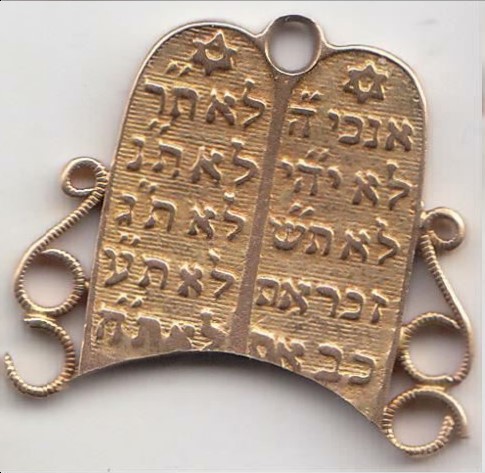
My father had made a bit of a ceremony leading up to this moment as he put the gold tablet into my hand. He didn’t want it to be a birthday present or a Hanukkah present because he said that would make it seem ordinary, like any piece of junk you could buy at Macy’s. This tablet was our family heirloom – the only thing that had been passed down from my grandfather, and even my great grandfather, going back before the Holocaust. Our family name is “Goldschmidt”, and so it was probably made by some ancestor hundreds of years ago who was an actual goldsmith. I have to say that it was pretty unimpressive. Just a small gold plate less than two inches tall, cut to look like the pillars of the Ten Commandments. I asked my dad if the tiny indentations said anything.
“Well, according to Zayde Shelomo, that’s an aleph, the first letter of the first of the Ten Commandments, and each little indentation is the first letter of each of the commandments. We took it to an expert and he agreed, even though they’re hard to make out now.”
Zayde Shelomo is my grand dad Sol, who is almost eighty now. I don’t get to see him much because he’s in a senior living center way out in Palm Desert. But Dad explained that his own Zayde Izzy had passed it to Sol, and then to him, and now that my wife Ruth and I have a son, it was time for me to take on the Goldschmidt treasure.
Gold is pretty heavy and so, having the tablet in the palm of my hand, I really could feel the weight of generations. I moved it back and forth to appreciate the heft of the Goldschmidt name. It was a little dull, and I learned that my dad and grand dad had avoided polishing it because they didn’t want to wear down what was left of the Hebrew letters. And just having the Ten Commandments on it carried their own weight, the weight of history.
I can still remember that heft from a month ago when I first received the tablet. Picking it up now, it feels really really heavy. More like lead than gold, so I put it down on something solid, our dining room table. Even then I’m half afraid it would burn right through the wood.
The story started because I asked my dad if grandpa Sol gave the tablet to him when I was born, and if he made such a ritual of it at the time.
This is what he told me. This is what my dad told me:
“I don’t think your Zayde Shelomo really has the same appreciation for this treasure and our family history that I do. When I received the tablet, he had a sort of uncomfortableness. ‘Here’s our family history, we’re a long line of Goldschmidts, take it, and I’m done with it.’ And then, it was much shinier. So, to me, it was beautiful in so many ways. There’s the beauty of the gold. There’s the power of the Ten Commandments and the Hebrew lettering that was still almost impossible to make out then. But I think that maybe my father was ashamed that he came from a line of people who worked with their hands, like ordinary artisans, which is silly because what else could we do hundreds of years ago? And being a goldsmith, was a fine honorable craft! And you know what’s even crazier? I’m a surgeon. I work with my hands for a living. I’m no different than a goldsmith. I use my mind to create a plan for how I will operate, and then my mind guides my hands to create something better than what was there before. To me, carrying on the name of Goldschmidt is an honor, and I am just carrying on the legacy of… who knows how many generations?
“That’s why when you told me you wanted to become a chef, I thought it was a little crazy. I wanted you to become a doctor like me. To me a chef is just a cook. What is there to make a hamburger? But then I realized, you’re just like all of us. You work with your hands. You’re creative. You’re a Goldschmidt.
Now your Zayde Shelomo, you may not know this, wanted to become a singer. He had a beautiful voice. He wanted to be a Frank Sinatra or an Eddie Cantor. When he was just twenty, he had a sort of manager who would take him to nightclubs and restaurants. The drinking age was eighteen then, so it was acceptable. According to him anyway, people loved him. But it takes a while to get established, to make a name, to play bigger places, to get a recording contract. His father Izzy didn’t like it. He wanted my dad to have a trade. He just stopped supporting him, and my dad had to take care of himself. Having to make money that way, that’s a lot of pressure, and dad said he carried it with him whenever he sang. His singing was still good enough to get some shows, but it was missing something. The beauty that comes with confidence. And then he made the great mistake of his life. He was singing at a supper club in Hollywood and saw a pretty girl at one of the tables with her date, and he sang really well for her. I just hope it was a first date because that poor schmuck didn’t have a chance. She ignored the guy the whole evening, and apparently he knew he was out of his league. He shouted from the table “get off the stage you fuckin’ kike.” Your grandfather didn’t have to raise a hand. The audience – told THE MAN to shut up, and according to Sol, they started throwing napkins and food right off their plate at the guy. I don’t think they loved Jews, but I guess they loved my dad’s singing. And then, the GIRL belted him. The GIRL. It turned out, she was Jewish! And when your own date belts you, either you kill her or just get the hell out of there. And fortunately, he got out.
And then the next thing you know, I was born. Your grandma Paula is one tough lady.
But then dad had a mouth to feed, and you know how I eat. I ate even more then. He gave up singing and got a job in a car repair shop. So, singing in that joint was the great mistake of his life. But I’m here and you’re here, and so it’s not so bad. God pulled him back into working with his hands. He’s a Goldschmidt.
And that’s why I think Zayde Shelomo didn’t show the sort of reverence for the tablet that I do, and that I hope you will. He wanted to escape the family tradition. I want to be a part of it. I want it to carry down for the next two hundred years, or however long it was when the tablet was first created.”
And so I asked my dad: “Is that what he told you, or is that what you think?”
Dad said “I never talked with him about it. He gave it to me, told me to take care of it and pass it on to my first born son, and that was it. But I think he was pretty hurt about being a car mechanic instead of a singer. He hardly ever sang for me. But sometimes I heard him singing the Frank Sinatra song “My Way” to my mom in the bedroom. But the thing is, he didn’t get to do it his way.”
That’s when I decided to visit my Zayde Shelomo out in Palm Desert. I wanted to hear from him what the tablet meant to him.
I hate the two hour drive it takes to visit him, and so I only visit Sol with my dad a couple of times a year. He likes it out in the desert because he can live with other people his age in a place that’s inexpensive enough and close enough to a golf course so that he can play a couple of times a week.
I wasn’t sure whether to tell him why I was coming or not. Suppose he doesn’t want to talk? I don’t want to make the trip for nothing. But what if I tell him why I want to speak with him before I come over, and he tells me not to? If I just show up, then at least there’s a chance – he’ll see the tablet and it will trigger something. I finally arrive at his complex. He invites me into his home and we hug and chat and I feel like I’m just wasting words on him because all that’s on my mind is finding the moment when I can ask him about the tablet.
It’s when I take him to dinner that he sees me squirming. The tablet is in a little box in my pocket, and it digs into my leg. I reach down, and struggle in my pocket a little, and I finally squeeze the box up and out, and now it’s in my palm.
“Dad gave this to me a few weeks ago. I thought you’d want to see it.” And then I open up the box, pull out the tablet and put it in my palm. “It’s the Goldschmidt family heirloom.” I say. “It carries our name down through the generations.” And then I wait.
“I heard about your son, Joshua” he tells me. “Mazel tov.”
Sneaky. He’s changing the subject by getting me to talk about Josh. Normally I’d be talking about him for the next hour, but I’m on a mission. So I try to get back to the subject. “Ruth and I wonder what he’ll be when he grows up.”
“What do you want him to be? A lawyer? A bullfighter? A real estate developer?” he asks with obvious coyness.
“He’s got beautiful hands. I think he’s an artist. Maybe he’ll become a sculptor” I tell him.
“The next – who’s the French guy who did The Thinker?”
“The next Rodin?” I ask.
“That would be nice. I wish I could be here long enough to see his works in the museum,” he says.
He’s not flinching. So I take his hand and I put the tablet in his palm. “We’re natural artists,” I say. And then he carefully wiggles his hand and lets the tablet fall onto the napkin on the table. “I’m sorry that you never got to be a singer, Zayde. Maybe later we’ll go back to your place and I’d like hear you sing something. I heard that you don’t appreciate the history in the gold tablet because you never wanted to work with your hands.”
“I see your dad told you the story of how he was born. Let me tell you something. I’m fine with the path my life took. I had a beautiful wife, and I have a beautiful son and a beautiful grandson. But I appreciate the history of the tablet too well” he told me.
Maybe I was getting somewhere because my grandpa was no longer speaking in his coy ingratiating voice. “Dad said it you didn’t like it because it symbolizes the Goldschmidt trade of working with your hands. Did your dad Izzy work with his hands?”
“I love your father more than I love my life, but he’s willfully blind. He never asked the questions you’re asking because he just assumes things. No, Izzy didn’t work with his hands.”
This is what he told me. This is what my grandpa told me:
“It’s a miracle that this tablet made it through the generations. My father Izzy was a concentration camp survivor, and when Buchenwald was liberated by the Americans, this was his only possession. But how does a Jew hang onto a scrap of gold in a concentration camp? Because unlike everyone else at Buchenwald, Izzy never worked with his hands. He worked as a kapo; he worked for the Nazis helping to run the camp.
“Izzy and my uncle Eli were rounded up from Berlin at the same time. First, they were sent to the ghetto in Bialystock where they were just in miserable crowded conditions, but they still kept the shirts on their backs. But then eventually, like all Jews in the ghetto, they were shipped on the cattle cars to the concentration camps. When they arrived at Buchenwald together, my dad impressed some of the Nazis because he spoke German to the Germans, and Yiddish to the Jews, and Polish to the Poles. And he was strong for a man who had been living in the ghetto. His older brother Eli, HE worked with his hands as a butcher. He wasn’t as bright or educated as my dad. But he overheard the Germans speaking with Izzy when they asked him if he’d like an easy job taking care of the prisoners. Izzy wasn’t sure what the catch was, but Eli ran up to him, told him to take the job. Then he secretly put the gold tablet into Izzy’s hand and asked him to hold onto it for him until hopefully they survived and would become reunited.
“Eli disappeared. And my father Izzy was put to work. He had to watch over the other prisoners, take roll call, clean up their lice, make them work hard, and beat them up when they didn’t work hard enough. My father never said how bad the beatings were, but I think that over time, he became pretty brutal. How do I know it? Well, he always had bruises on his knuckles that never healed, and he’d never talk about it with me when I asked. But also, they promoted him. He went from working in the camp, doing disgusting things like personally picking off the lice from the prisoners, and watching over them in the winter, to nicer things. He got to supervise other kapos. He got to work indoors, in the kitchen. He ate better than the other prisoners. They got thin soup that he said smelled like rubber. He got good lentil soup and sausage. And it was when he was working in the kitchen that he saw uncle Eli again, after more than a year. The way he described it, Eli was so thin, that Izzy felt that he was fat, like the two were Laurel and Hardy. Only in reality, Izzy was thin and Eli was just bones. But Izzy could always keep Eli happy by showing him that he still had the gold tablet, that the Nazis let him keep it, along with normal civilian clothes.
“But then they had a bad winter. There was less food. The Jews were dying. They were either collapsing, or getting disease, or they couldn’t work – in which case they were loaded off to the gas chamber. To hear my father describe it, Eli was so thin, his eyes looked like they were going to fall out of their sockets. Eli knew, any day, he was going to be taken to the gas chamber. He couldn’t keep up with the work. He went up to his brother in secret and told him ‘Please, let me live. Give me some of the real food that the Germans let you have. Please, you’re a powerful man. Share half of your soup and sausage with me and I’ll have enough strength to survive.’
“And my father said ‘Yes. But on condition that you let me keep the gold tablet. I know I’m a scholar, not a butcher, but I also want to be a Goldschmidt.’ So what could Eli do? If he died, he’d have no use for the tablet any way. So, he traded the family heirloom for soup.
“And they both made it through the war. But when the Allies liberated Buchenwald, they went their separate ways and never saw each other again.
“My father met mom when the Allies were sorting out all the prisoners. They came to America, married, and had me.
“So this gold tablet? We only have it because Eli traded it away for some soup. That’s why I don’t like to handle it. I don’t care about my singing career. God willed that I become a car mechanic. But maybe, who knows? Maybe God’s will is contained in the Goldschmidt tablet. Maybe if Eli had it, his son would have become a mechanic or work in a factory, and I’d be a singer. Or maybe I’d just be a bum. We’ll never know.”
I’m at home now, staring at the tablet which threatens to burn through the table it’s sitting on with the heat and weight of its sins. The only way I can think of atoning is to find out where Eli’s descendants are living today. The tablet needs to be returned to the line of Eli, the rightful Goldschmidt heir.
I’m on my own. I can’t ask my father about Izzy or Eli because if I said I wanted to hand the tablet over, he’d lose the pride in his identity as a part of the centuries of Goldschmidts, and that he might even be disappointed in me as also no longer a part of that chain. But there is no one else to ask.
I go through war records and immigration records, looking for the Goldschmidt brothers who had been rescued from Buchenwald, but strangely I find only one such name – Isadore Goldschmidt, my great grandfather. But my grandpa Sol said that both brothers survived but went their separate ways. There were over twenty thousand people rescued from Buchenwald. Finding Eli’s children would be as hard as if I had personally tried to rescue him from the concentration camp myself. I go through the records looking at first names, and I find a couple of Eliezers and three Elijahs.
Eliezer Greenbaum. Eliezer Klein. Elijah Bernstein. Elijah Handelman. Elijah Berg.
None of them is a “goldsmith.” There’s a “green tree”. Eliezer Klein – that means “Small” – probably a huge guy. Bernstein “Hill stone”. Handelman – trader.
Whoa. Eli was no longer a goldsmith. He had sold the treasure of his ancestors. Perhaps he had taken on the name of a trader.
And so I searched through ancestry websites and learned that there was an Eli Handelman in Florida. An Eli Handleman who was one-hundred-and-two, and living in a nursing home. Aptly, the “Golden Age Center.” I told my wife that I would be gone maybe four days, and I flew to Fort Meyers.
The woman at the desk explained that unexpected visitors could not see their patients, and it would not matter if I had flown in directly from Buchenwald.
“Please tell him that Izzy Goldschmidt’s great-grandson is here, and he has the gold tablet.”
When the orderly returned, she told me that Eli had never looked so excited in the past ten years. She walked me to Eli’s bed, where she explained that Eli’s mind was very strong, but he was very delicate and blind. Indeed, on seeing him I felt transported to Buchenwald. Like the pictures from concentration camps, Eli was emaciated; his eyes floated in their sockets, but they were clouded over.
“Hello, Eli” I said and sat next to him. “I came here because I wanted you to hold this again” and I took his hand and put the gold tablet into it. He smiled and then wiggled it, as his way of telling me to take it back. I told him the story of how he traded it for soup. “I want to atone for that. I want to give this to your grandchildren. If you like, you can have the nurse give me a bowl of soup so that we can trade it.”
This is what he told me. This is what Eli told me:
“Atoning you want? I don’t believe in that. I haven’t been to a Yom Kippur service since America. You can’t atone because the past is already gone. You want to make things better you start today. Your zayde said Izzy forced me to sell him the tablet? No. I made the offer. And I got exactly what I wanted. I got fed, and I got to know that the tablet could continue. Tell me, you work with your hands?”
“I’m a chef, Eli. My dad is a surgeon.”
“Perfect!” he said. “And I’m a trader. I built up an import-export business and I became very rich. My son started a chain of beautiful department stores. Eli Goldschmidt died in Buchenwald and Eli Handelman was born in America.”
He wiggled his hand around like he was looking for mine, and so I gave it to him. He felt for the tablet and he closed my fingers on it.
“Keep this.” Eli told me. “You are a Goldschmidt. I’m very glad you came to me so that I know it is still being passed down through the generations through its rightful line. But I want you to lean in, so that I may give you my blessing.”
I leaned in and when I felt his breath on me and I knew he felt my own breath, he put his hand on my head and pulled me to his lips.
“Never atone. Look to the future always. And most important, have lots and lots and lots of children.”